They begin with the same plant
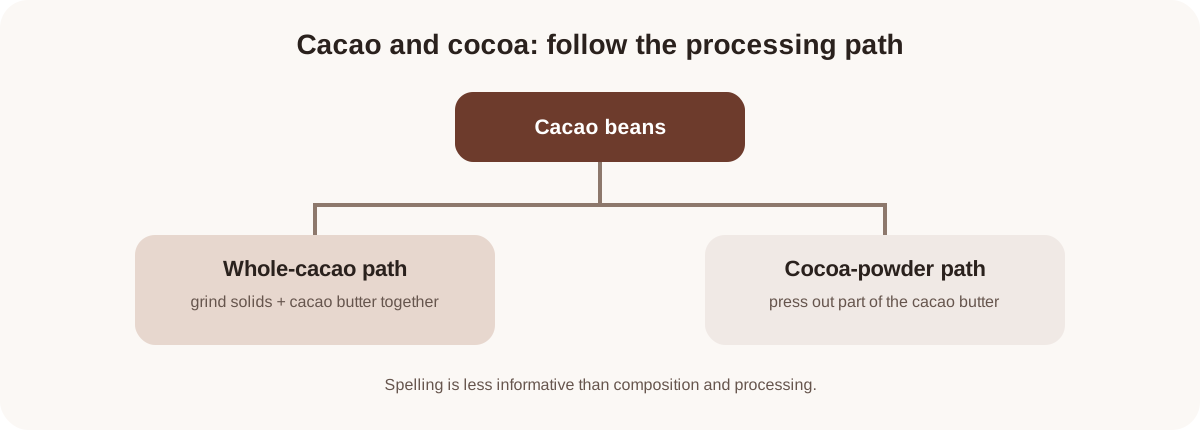
Cacao and cocoa both come from Theobroma cacao. In everyday marketing, however, the words are used inconsistently. Two products labeled “cacao” can differ more from one another than a cacao product and a cocoa product.
| Product form | What is typically present | Common use |
|---|---|---|
| Whole cacao paste | Cacao solids and cacao butter together | Drinking cacao, chocolate making |
| Full-fat ground cacao | Finely ground whole cacao | Drinking cacao |
| Cocoa powder | Partially defatted cacao solids | Baking, beverages |
| Dutch-process cocoa | Alkalized cocoa powder | Baking, smoother-flavored drinks |
| Hot chocolate mix | Cocoa plus sugar and often other ingredients | Sweet beverage |
Why this matters for ceremonial cacao
Whole cacao generally produces a richer, more emulsified drink because the cacao butter remains. Cocoa powder behaves differently in water and is commonly used at different quantities.
For the most practical comparison, continue to Cacao Paste vs. Cacao Powder.
Sources & further reading
A side-by-side shopping example
Package A: cacao paste
A product described as 100% cacao paste generally indicates ground cacao material retaining its natural fat. Check the ingredients rather than assuming the marketing term defines processing.
Package B: cocoa powder
A powder may have had much of its cocoa butter removed. “Natural” and “Dutch-processed” can describe different treatments; compare the package information.
What to conclude
The name alone does not prove superiority. For a ritual drink, prioritize composition, flavor, preparation requirements and sourcing transparency.