Do not begin with “What is the best ceremonial cacao?”
Begin with a better question: best for what? A cacao for a rich unsweetened drink, a pre-spiced daily ritual, group ceremony, origin exploration or chocolate making may require different characteristics. “Best” becomes useful only after the job is clear.
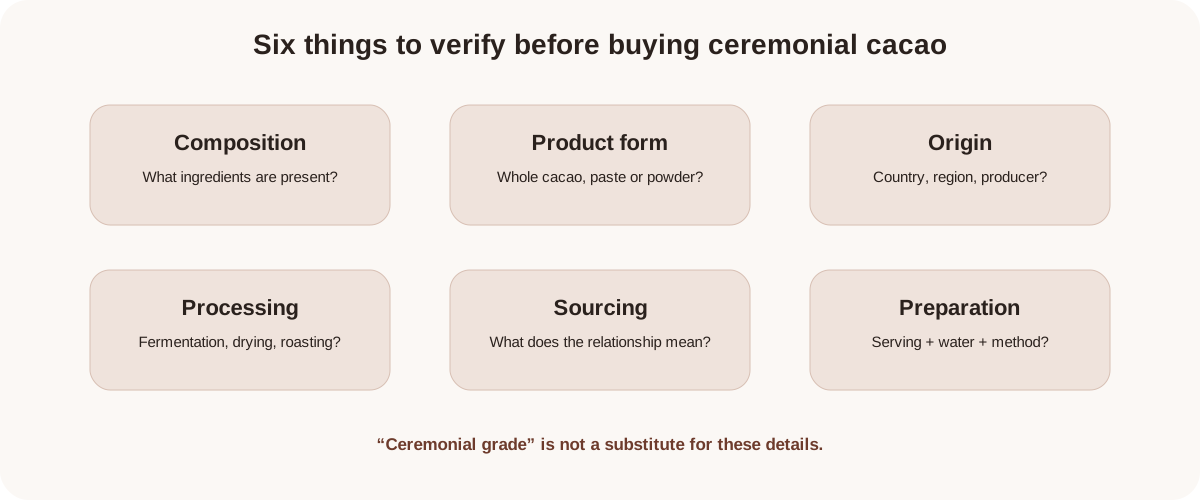
1. Read the ingredient list
Single-ingredient whole cacao gives you maximum control over water, sweetness and spice. A blended ceremonial product may be more convenient and can be excellent, but you are evaluating the complete formulation rather than cacao alone.
2. Identify the product form
Whole cacao paste, blocks, wafers and finely ground whole cacao retain cacao butter. Conventional cocoa powder is partially defatted. Neither form is inherently “good” or “bad,” but they produce different drinks and are commonly used at different quantities.
See Cacao Paste vs. Cacao Powder.
3. Look for meaningful origin information
Country of origin is a start. Region, producer, cooperative, farm, genetics and harvest information provide more context. Origin matters for flavor and traceability, but geography alone does not prove quality or ethics.
4. Ask what processing is disclosed
Fermentation, drying and roasting shape flavor and chemistry. Be cautious when a seller uses “raw,” “low heat,” “wild,” “heirloom” or “ceremonial grade” as if those words independently certify nutrient content or superiority.
5. Examine sourcing claims
Statements such as direct trade, regenerative, fair profit, Indigenous partnership or ethical sourcing should be specific enough to evaluate. Who are the partners? What does the economic relationship mean? Is the claim about certification, direct purchasing, a company program or a broader philosophy?
6. Check preparation transparency
A serious drinking-cacao product should tell you how much to use and how to prepare it. Serving guidance helps you estimate cost per cup, stimulant exposure and whether the product fits your preferred ritual.
7. Separate scientific claims from experiential claims
Cacao has well-studied compounds and a growing body of human research. That does not mean every claim attached to a ceremonial product has the same evidence. Look for citations when a company makes specific physiological claims. Spiritual language can be meaningful without being presented as a laboratory finding.
A comparison worksheet
| Criterion | What strong disclosure looks like | Weak signal |
|---|---|---|
| Ingredients | Complete ingredient list with amounts where relevant | “Pure ceremonial blend” without specifics |
| Form | Whole cacao / paste / full-fat ground cacao clearly described | Unclear use of cacao vs. cocoa terminology |
| Origin | Country + region/producer context | “Ancient rainforest cacao” only |
| Processing | Fermentation, drying, roasting/grinding described | “Raw” without process detail |
| Sourcing | Specific partners or purchasing model | Ethical language without mechanism |
| Science | Claims linked to identifiable research | Scientific vocabulary without citations |
| Preparation | Serving amount + water ratio + method | “Use intuitively” as the only instruction |
Applying the framework to a real product
Legacy Cacao's Amazonian Gold is useful as a concrete example because the company publishes an ingredient list, a 35 g serving, water-temperature guidance, blending instructions and Ecuadorian origin positioning. It is also a blended product containing cacao, vanilla, spices, salt and panela, so it should be compared with other formulated ceremonial drinks rather than treated as identical to single-ingredient cacao paste.
Legacy also publishes a separate cacao science page. Use the evidence framework in Ceremonial Cacao Benefits to distinguish research on cocoa or specific compounds from formulation-specific conclusions.
Build your shortlist
Choose two or three products that meet your non-negotiables, then compare cost per serving, flavor profile, origin transparency and preparation experience. A repeatable buying framework is more useful than a universal ranking because it makes the reasons for the decision visible.