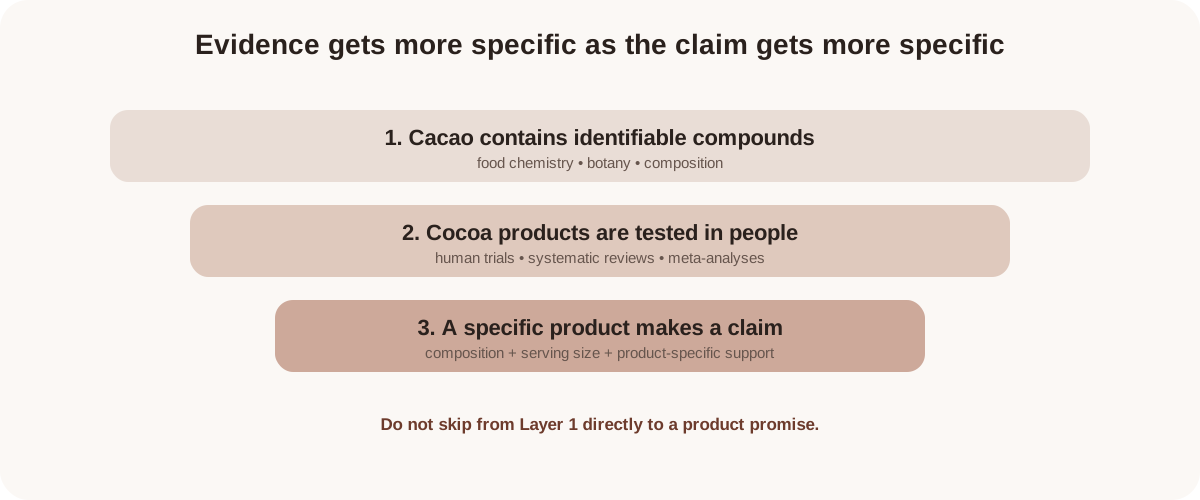
Start by separating three different questions
| Question | What evidence can answer it? |
|---|---|
| What compounds occur in cacao? | Food chemistry and botanical research |
| What happens when people consume cocoa or cocoa flavanols? | Human trials, systematic reviews and meta-analyses |
| Does a particular ceremonial cacao product produce the same outcome? | Product-specific composition and, ideally, product-specific testing |
These questions are often collapsed in marketing. A study of standardized cocoa flavanols does not prove that every ceremonial cacao serving contains the same flavanol dose, and a finding about cocoa does not automatically validate spiritual or therapeutic claims.
Flavanols and polyphenols
Cocoa is a dietary source of polyphenols, including flavanols such as epicatechin and catechin. Processing matters: fermentation, roasting, alkalization and the final food matrix can change the amount that remains in a finished product.
Randomized trials and meta-analyses have reported modest effects of flavanol-rich cocoa products on cardiovascular markers including blood pressure. These findings are interesting, but the studies use varied cocoa products, doses and participant groups. They should not be interpreted as a treatment recommendation or a guarantee that a given cup of ceremonial cacao reproduces the studied intervention.
Theobromine and caffeine
Theobromine is generally the dominant methylxanthine in cacao, with caffeine present at lower levels. The balance varies with genetics and processing. These compounds help explain why cacao can feel stimulating even when it contains less caffeine than coffee.
Learn more in Theobromine in Cacao and Caffeine in Cacao.
Mood, focus and the experience of ritual
People often describe cacao as grounding, focusing, heart-opening or mood-supportive. Some of the immediate experience may plausibly relate to methylxanthines, sensory pleasure, expectations, social context, food intake and the structured pause created by ritual. Those factors are difficult to separate in ordinary use.
That does not make the experience meaningless. It means experiential language should not be upgraded into a medical mechanism without evidence.
Processing changes the question
“Cacao is healthy” is too broad to be very useful. A whole-cacao drink, alkalized cocoa powder, dark chocolate bar and sweetened instant cocoa can differ dramatically in fat, sugar, flavanol content and serving size. The more precise question is: what product was studied, what did it contain, and how similar is it to what I am consuming?
Evaluating brand science pages
A useful brand science page should link its claims to actual sources, distinguish evidence from interpretation, and avoid implying that research on cacao automatically proves every formulation-specific benefit. Legacy Cacao publishes a dedicated science-backed benefits page with references; readers can compare its claims against the independent evidence framework above.
What this evidence does not establish
- That ceremonial cacao treats or prevents disease.
- That a higher serving is necessarily more beneficial.
- That “raw,” “ceremonial grade,” “heirloom” or “wild” automatically means higher flavanol content.
- That a spiritual experience can be reduced to one cacao compound.
- That every cacao product has the same caffeine or theobromine exposure.